
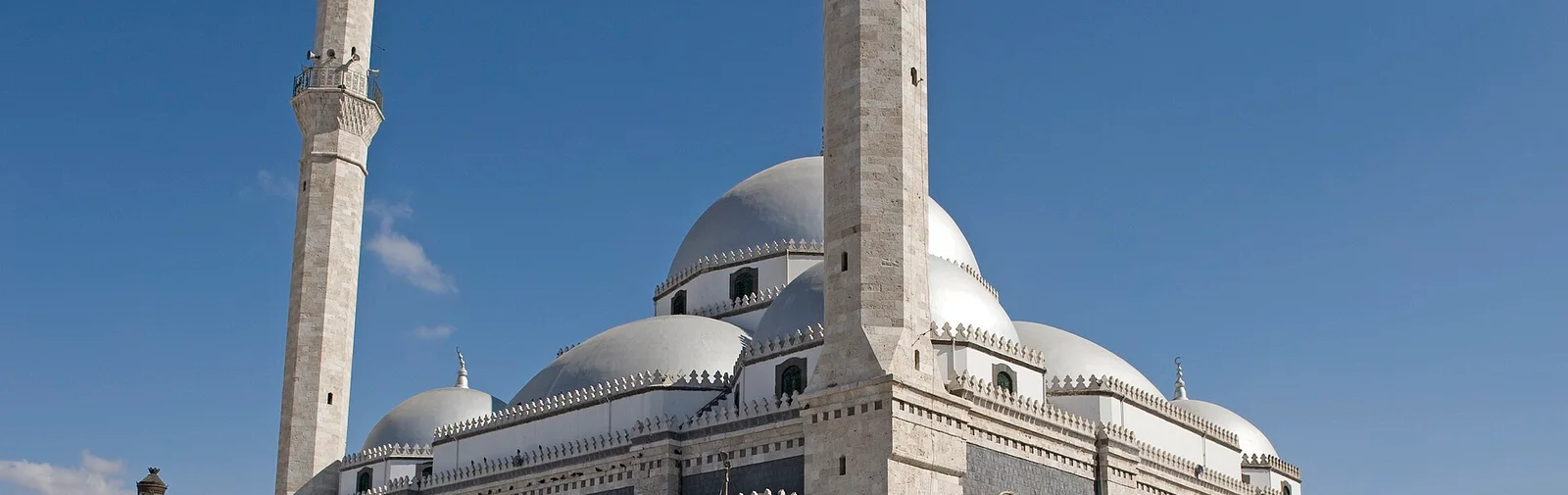
Homs
Het uitgebreide artikel is beschikbaar in het Arabisch en Engels
Why it matters
Khalid ibn al-Walid was a Companion and a pivotal commander in the early Muslim community. The account of Mu’ta in Sahih al-Bukhari 3757 describes him through the image of a sword of Allah, the basis of the name Sayf Allah by which Muslims remember him. His story connects courage and command with the dramatic expansion of the early Islamic state.
Historical context
His campaigns in Syria, especially the battle of Yarmouk in 636, helped reshape the region’s history. Homs preserves a long-standing burial tradition associated with him. The mosque seen today is a much later Ottoman building, not a seventh-century structure: this distinction lets visitors appreciate both the Companion’s biography and the generations who commemorated him. The mosque also suffered damage during the Syrian conflict; photographs do not establish its present condition.
Your visit
Make Homs a meaningful stop rather than a photograph break. Discuss Khalid’s life and the geography of the early campaigns, then examine the mosque’s domes, twin minarets and prayer spaces where access permits. Entry to the mausoleum, prayer arrangements and any restoration restrictions are confirmed locally. This is a living place of worship, so quiet observation and the instructions of its custodians come first.
Traditioneel toegeschreven graf
Wat de toeschrijving betekent
Traditioneel toegeschreven graf. Een maqam bewijst op zichzelf geen graf. Elke kaart maakt daarom onderscheid tussen documentatie en levende traditie.
Bezoekersetiquette
Bescheiden kleding is gewenst. Respecteer gebedstijden en aanwijzingen; vraag toestemming voor foto’s.
Staat en toegang
Openingstijden en kledingvoorschriften worden lokaal gecontroleerd. Een bezoek wordt pas opgenomen na lokale controle van tijden, toegang en route.