Bosra
Het uitgebreide artikel is beschikbaar in het Arabisch en Engels
Why it matters
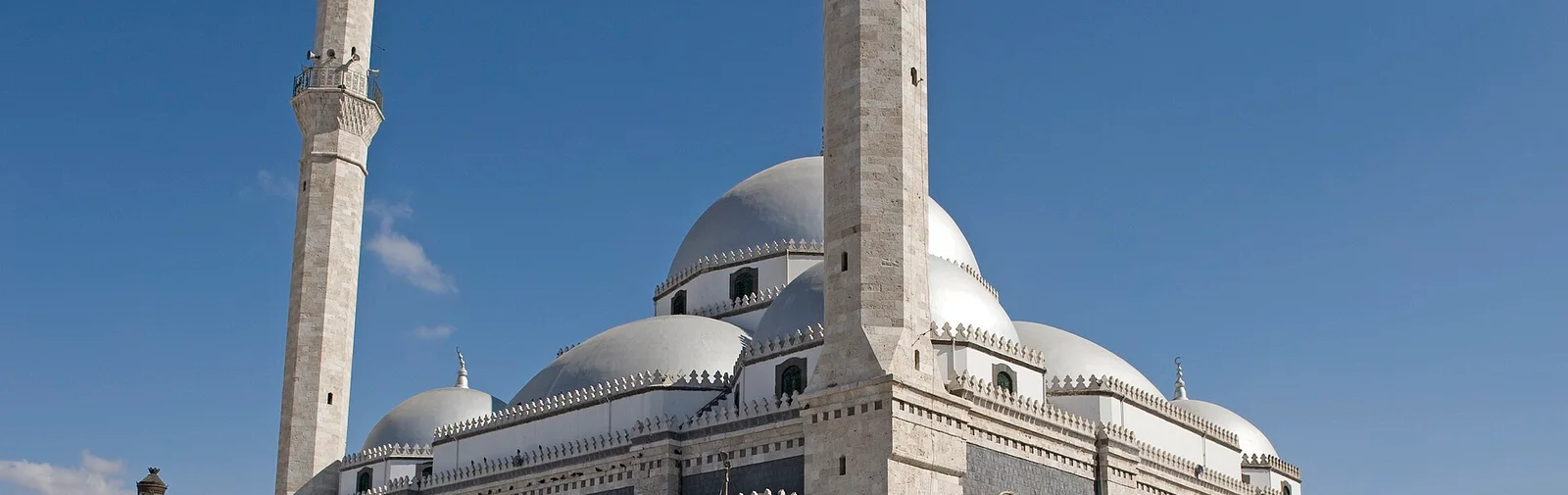
Al-Omari Mosque gives Bosra’s story an essential Islamic chapter alongside its famous Roman theatre. The dark basalt of the town gives the mosque a distinctive material character. Its name recalls the caliph Umar, while the building’s history includes later phases: a traditional foundation association should not be used to date every surviving wall to his lifetime.
Historical context
The mosque illustrates how an ancient city continued to develop under Muslim rule. Rather than treating Bosra as a Roman site with a brief mosque stop, a guided walk can trace the relationship between streets, religious buildings and the wider landscape of southern Syria. Its importance lies in this continuity as well as in its place among Syria’s early mosques.
Your visit
Explore the exterior, masonry and accessible spaces in connection with the surrounding old town. Ground conditions and the availability of interior access are checked locally. This visit pairs naturally with a discussion of pilgrimage and movement through the Hauran, with a slower pace for uneven basalt surfaces.
Architectonische of cultuurhistorische site
Wat de toeschrijving betekent
Architectonische of cultuurhistorische site. Een maqam bewijst op zichzelf geen graf. Elke kaart maakt daarom onderscheid tussen documentatie en levende traditie.
Bezoekersetiquette
Bescheiden kleding is gewenst. Respecteer gebedstijden en aanwijzingen; vraag toestemming voor foto’s.
Staat en toegang
Bezoek onder voorbehoud van actuele toegangscontrole. Een bezoek wordt pas opgenomen na lokale controle van tijden, toegang en route.