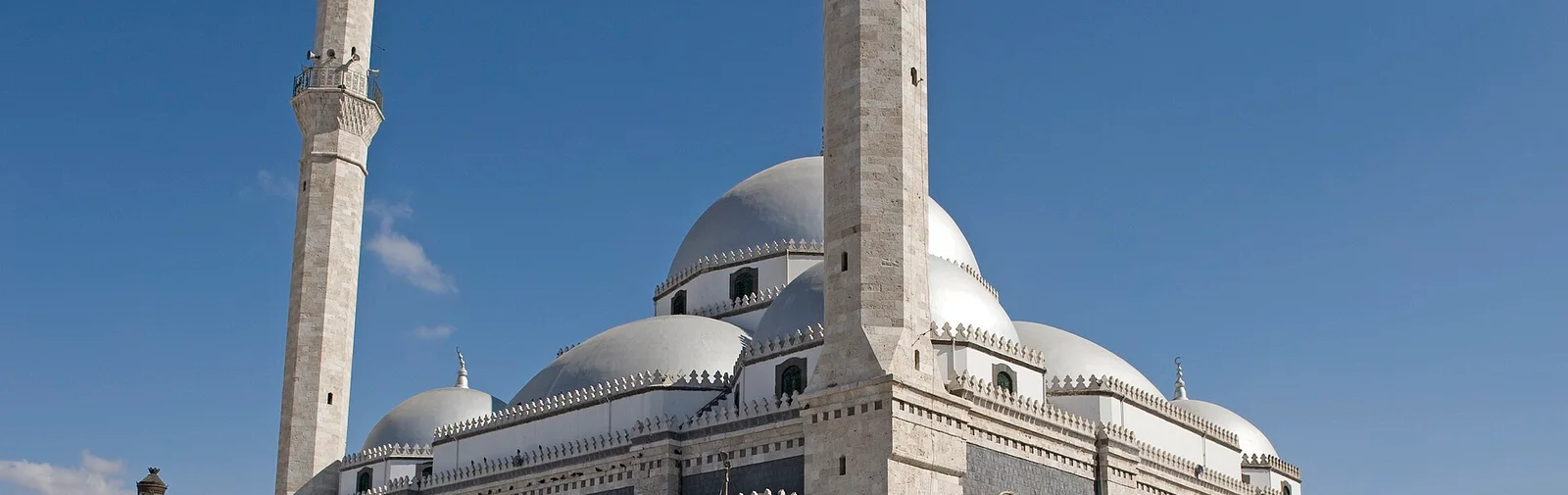
Bosra
El artículo completo está disponible en árabe e inglés
Why it matters
Al-Omari Mosque gives Bosra’s story an essential Islamic chapter alongside its famous Roman theatre. The dark basalt of the town gives the mosque a distinctive material character. Its name recalls the caliph Umar, while the building’s history includes later phases: a traditional foundation association should not be used to date every surviving wall to his lifetime.
Historical context
The mosque illustrates how an ancient city continued to develop under Muslim rule. Rather than treating Bosra as a Roman site with a brief mosque stop, a guided walk can trace the relationship between streets, religious buildings and the wider landscape of southern Syria. Its importance lies in this continuity as well as in its place among Syria’s early mosques.
Your visit
Explore the exterior, masonry and accessible spaces in connection with the surrounding old town. Ground conditions and the availability of interior access are checked locally. This visit pairs naturally with a discussion of pilgrimage and movement through the Hauran, with a slower pace for uneven basalt surfaces.
Sitio arquitectónico o civilizatorio
Qué significa la atribución
Sitio arquitectónico o civilizatorio. Un maqam no prueba por sí solo un entierro. Cada ficha distingue la documentación de la tradición devocional viva.
Respeto durante la visita
Se espera vestimenta modesta. Respete oraciones e indicaciones; pida permiso antes de fotografiar.
Estado y acceso
Visita sujeta a verificación actual del acceso. La visita se incluye solo tras verificar horarios, acceso y ruta.